Feature Story
WE HIGHLIGHT FOUNDERS WHO ARE LEADING WITH PRESENCE
Why Nausheen Chen Is the Voice We are Beginning 2026 With
By Pamela Zembani
Photos courtesy of Nausheen Chen
“Being in the spotlight wasn’t about attention. It was about finally being heard.”
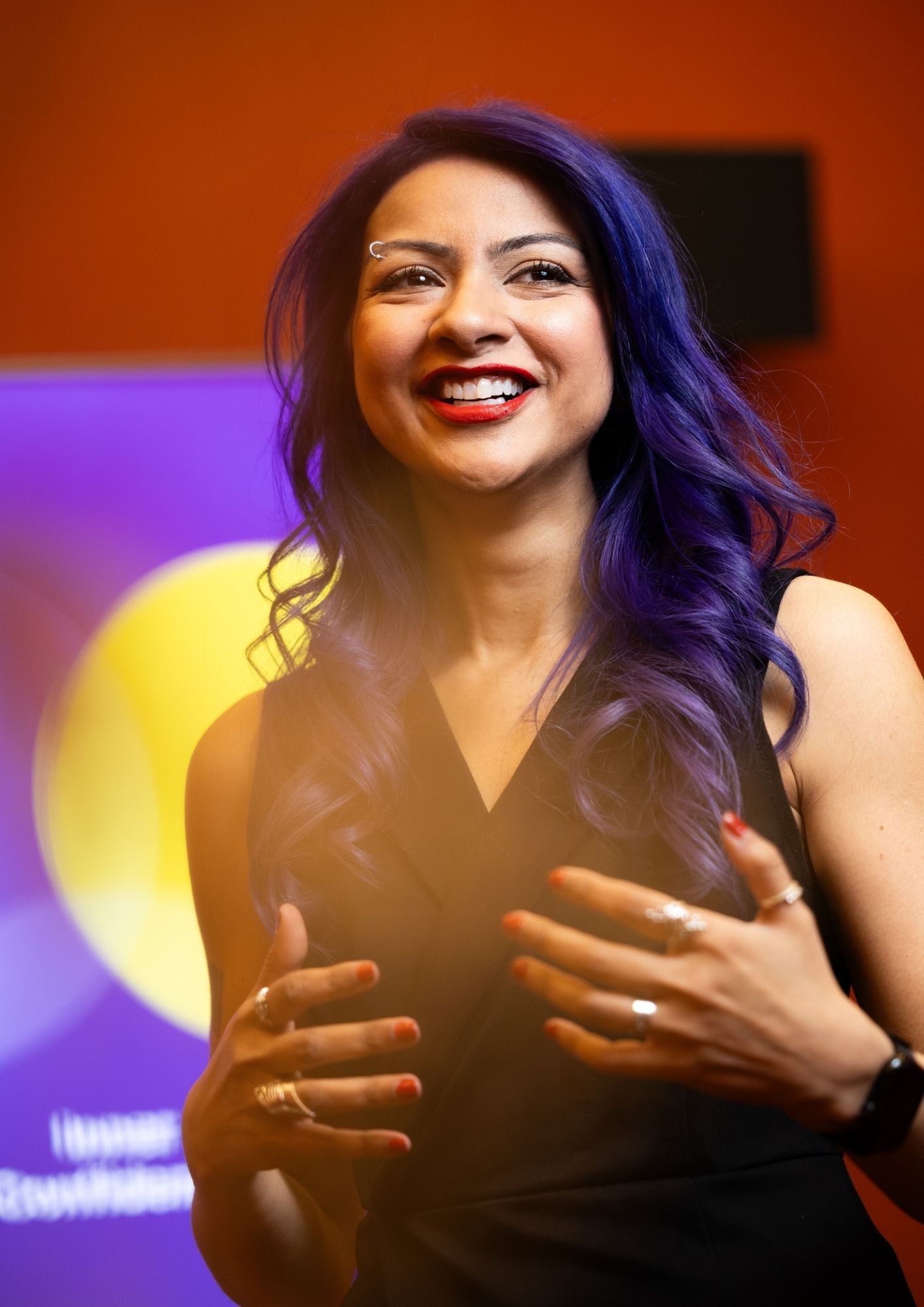
The first thing you notice about Nausheen Chen isn’t the purple hair—though it is unmistakable, deliberate, and quietly defiant. It’s the way she speaks. Not loudly. Not theatrically. But with a grounded clarity that suggests something lived-in. Earned. A voice shaped by years of being unheard, and by a conscious decision not to stay there. There’s no rush in her cadence. No apology for the space she occupies. She speaks the way someone does when they know they have nothing to prove—and everything to offer. That’s what makes her the right beginning for 2026. Not because she teaches people how to speak. But because she understands, intimately, what it means to disappear, to doubt the worth of your own words, and how radical it is to choose visibility anyway. In a digital economy saturated with noise, Nausheen’s work centers on something deceptively simple: presence. And presence, she insists, is not about performance. It’s about permission first, the permission you give yourself.

Childhood, Adoption, and the Birth of the Stage
Nausheen often laughs when she talks about her childhood. The laughter is affectionate, slightly incredulous—like she’s watching a younger version of herself from a distance. She remembers being that kid. The one who stood up at family gatherings. The one who recited poems no one had asked to hear. The one who performed simply because the opportunity existed. “I loved performing,” she says. “Every chance I got.” That love didn’t come from ego. It came from necessity.
Nausheen was adopted later than most children. Everyone else in her family was much older. In a household of adults, she was perpetually the youngest voice in the room—and therefore, the easiest to overlook.
“I learned early that if I wanted people to listen, I had to take the stage.”
“My opinions didn’t really matter,” she says, without bitterness. “And in the eighties, especially, little kids weren’t exactly encouraged to speak up.” So she learned quickly: if she wanted to be heard, she had to earn attention.
“I realized that the only way to get people to listen to me was by taking the stage.”
The spotlight became a workaround. A portal. A place where age and hierarchy dissolved, and voice mattered more than position.
“Being in the spotlight was magical,” she recalls. “Because suddenly your ideas, your points of view—they were actually being received.For someone who had grown up feeling unseen, that sensation was electric.
“That was the way I found my voice,” she says.
She didn’t know it then, but this instinct, to step forward when others recede, would define her life’s work.
Learning That Voice Is a Bridge, Not a Weapon
No one ever sat Nausheen down and told her, Your story matters. That belief arrived indirectly, through observation and longing.As an only child, she spent long stretches alone. Books, television, radio—all became companions. She was raised on pop culture, especially the MTV generation, fascinated not just by music, but by the presenters who introduced it.
“I was lonely growing up,” she says. “And communication became my way of feeling connected to people.”
She didn’t consume passively. She studied. Why did one DJ feel intimate while another felt distant? Why did certain voices linger long after the broadcast ended?
“I started analyzing why I listened to certain people more than others,” she explains. “Why some communicators made it feel like they were speaking directly to me—even though they were addressing thousands, or millions.”
The answer wasn’t charisma alone. It was emotional precision.
“They had superior communication skills,” she says. “They made you feel seen.”That, she realized, was power—not dominance, but intimacy at scale.
“There are people who can speak to a hundred thousand people,” she says, “and yet when you listen, it feels like they’re speaking only to you.”
At nineteen, before she had graduated from college, she hosted her first radio show. It wasn’t a calculated career move. It was an instinctive step toward the place where she felt most alive.
“I always knew I wanted to speak to bigger audiences,” she says. “I just didn’t know what that would look like yet.”
The Intentionality of Appearance
If Nausheen’s voice is her instrument, her appearance is her amplifier. The purple hair—now synonymous with her brand—was never meant to be a statement for shock’s sake. It was, instead, an act of alignment.She traces the philosophy back to a scene in Richard Linklater’s Waking Life. A man dressed as a ship captain drives a car shaped like a boat. When questioned, he replies: Your appearance should be an extension of your personality.
“That line stayed with me,” Nausheen says. “Because whether we like it or not, people judge books by their covers.”
Her conclusion was pragmatic, not performative. “If people are going to judge anyway, you might as well be intentional.” When she began building her personal brand online, the purple hair was almost accidental. She had experimented with color for years—red, blue, violet—when her presence on LinkedIn began to grow.
“If people are going to judge anyway, you might as well be intentional.”
“But I realized quickly that it made me recognizable,” she says. “It got my foot in the door.” What mattered more, though, was what happened next.“Appearance can’t just be a gimmick,” she says. “It has to be backed up by who you actually are.” Energy. Enthusiasm. Independence. Precision.
Over time, something unexpected occurred. People started telling her that simply seeing her gave them courage.
“They said my presence made them feel more fearless, more unapologetic, more authentic,” she says. “That was never the goal—but it became the reward.”
The Invisible Work Behind Visibility
Despite her openness online, there is one aspect of Nausheen’s life she rarely showcases: stillness. Not because she doesn’t value rest—but because even rest becomes part of her craft.
“I’m a communication nerd,” she admits. “I can’t turn it off.”
She studies speakers while watching television. Saves YouTube clips mid-scene. Observes the rhythm of dialogue in films. Notices how people pause, how they recover when they stumble, how silence can be more powerful than sound.
“I have a library of over five hundred ideas,” she says. “All drawn from everyday life.”
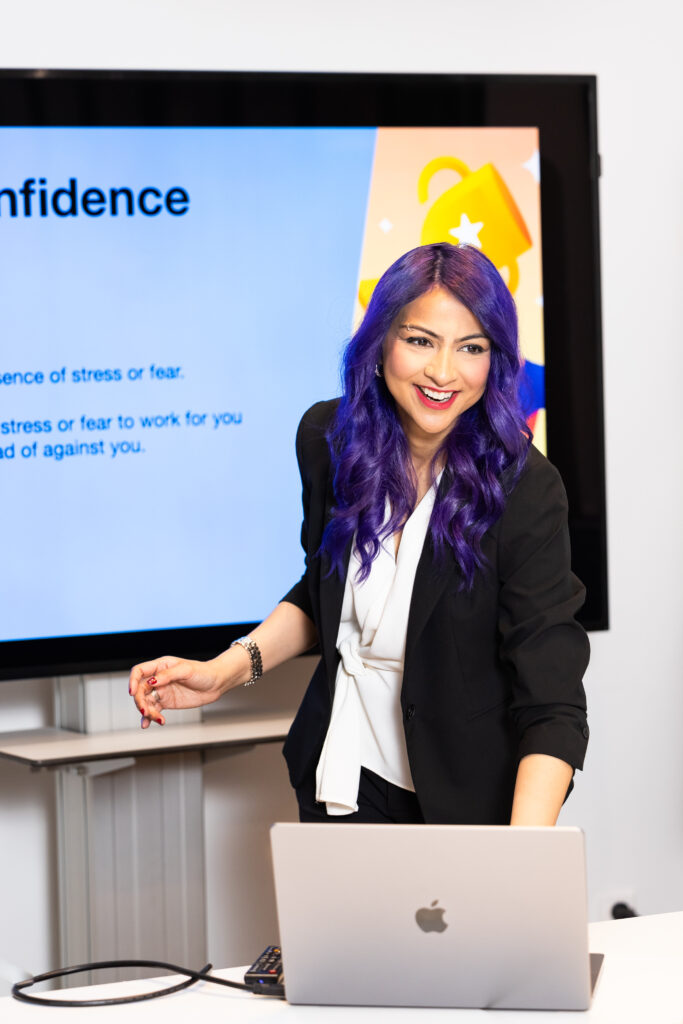
This constant observation feeds her coaching philosophy. She doesn’t teach scripts. She teaches awareness.
“Communication isn’t about memorizing lines,” she says. “It’s about understanding how humans actually connect.”
From Expertise to Exposure
For years, Nausheen built a successful career as a filmmaker and corporate trainer. Her work spoke for itself—within a contained circle.
“I relied on referrals,” she says. “I stayed within my own network.”
She wasn’t invisible. But she wasn’t visible either.
Then she made a choice that would redefine everything: she began showing up publicly.
Videos. Thought leadership. Teaching in real time.
“The moment I started building my brand on LinkedIn, my impact grew exponentially,” she says.
Her knowledge became accessible. Her expertise legible.
“If you don’t come out of the shadows, your expertise dies with you.”
“And this is where so many experts get stuck,” she explains. “They stay invisible because they doubt themselves.”
They worry their story isn’t unique enough. That they don’t know enough yet. That they’ll be judged. Her response is unambiguous.
“If you don’t come out of the shadows,” she says, “your expertise dies with you.”
Visibility, in her view, is not ego. It’s stewardship.
Confidence Beyond Performance
Nausheen’s journey complicates a common assumption: that confidence and competence always arrive together. As a young adult, she knew how to perform. She knew how to command attention. What she didn’t have was internal confidence.
“I could get on stage,” she says. “But inside, I didn’t feel secure.”
Over time, she learned that confidence isn’t a mask—it’s an agreement you make with yourself.
“It’s not about putting on a show,” she says. “It’s about believing yourself when you speak.”
Leaving her Fortune 50 career was a defining moment. She had the job others wanted. Prestige. Stability. Validation.
And she walked away.
“I quit without a backup plan,” she says. “I traveled. I experimented.”
Improvisation. Stand-up comedy. Acting. Directing.
“At the time, I didn’t know how it would all connect,” she admits. “But eventually, every skill shaped my work.”
Nothing was wasted.
Redefining Courage
Five years ago, courage looked like survival. During COVID, Nausheen was living in China, working as a filmmaker in an atmosphere of uncertainty.
“Courage then was making sure the business didn’t die,” she says. “Protecting people. Keeping things moving.”
Today, courage has evolved.
“Now it looks like making decisions that scale impact,” she explains. “Even when they’re uncomfortable.”
She is learning to prioritize—to say no to good opportunities in service of the right ones.
“I grew up believing I could do everything,” she says. “Now I’m learning that joy requires focus.”
Reflection, Ritual, and Recognition
This past year marked a turning point. For the first time, Nausheen set deliberate goals.
Three personal. Three professional.
“I achieved almost all of them,” she says. “And I felt something new—control.”
She now treats the final weeks of the year as sacred.
“No client work. No public-facing commitments,” she says. “Just reflection and planning.”
The result is momentum. One highlight stands out: speaking at Web Summit, the world’s largest tech conference, attended by tens of thousands.
“We worked hard for it,” she says. “But I’m still deeply grateful.”

2026 and the Shape of Legacy
Looking ahead, one project rises above the rest: her book.
“I’m making it a priority in 2026,” she says. “It brings everything together.” Communication. Identity. Visibility. Power.
When asked about legacy, her answer comes without hesitation.
“I hope they say I helped them find their voice,” she says. “That I helped them stop being invisible.”
Her advice for the year ahead is simple and radical.
“There is no advantage to staying silent,” she says. “You can be humble and still talk about your work.”
Progress only happens because someone speaks.
“There is no advantage to staying silent. You can be humble and still talk about your work.”
Looking ahead, one project rises above the rest: her book.
“I’m making it a priority in 2026,” she says. “It brings everything together.” Communication. Identity. Visibility. Power.
When asked about legacy, her answer comes without hesitation.
“I hope they say I helped them find their voice,” she says. “That I helped them stop being invisible.”
Her advice for the year ahead is simple and radical.
“There is no advantage to staying silent,” she says. “You can be humble and still talk about your work.”
Progress only happens because someone speaks.
Nausheen Chen is not just a speaking coach. She is a permission structure.
And she has made the foundations of her work freely available.
Her free course on speaking with confidence is open to anyone ready to step into visibility:
https://www.speaking.coach/free-course/
Because 2026 doesn’t need quieter brilliance.
It needs voices willing to be heard.