

Emotion as Strategy
We examine issues affecting experience
The Neuroscience of Decision Velocity
Why Customers Buy Faster When They Feel Safe — and Why Emotion Is Now the Core of Customer Experience Strategy
For decades, customer experience was treated as a surface-level discipline. Aesthetic improvements, usability upgrades, friendlier language, better service scripts. Emotion was considered a byproduct: something nice to have once functional needs were met. That era is over. Neuroscience, behavioral economics, and modern CX research now make one thing clear: emotion is not a layer on top of experience — it is the mechanism through which experience works. Customers do not move through journeys rationally. They move through them biologically. And when those biological systems sense safety, decisions accelerate. When they sense threat, decisions stall, regress, or disappear altogether.
This is why conversion slows even when value is obvious. This is why customers abandon carts they intended to complete. This is why loyalty collapses after a single moment of confusion. And this is why companies that design emotional safety into their experiences outperform those that optimize only usability, price, or persuasion. Decision velocity is not a funnel problem. It is a nervous system problem. And customer experience is now the primary system through which that problem is solved.
BY PAMELA ZEMBANI
The brain decides before the customer knows it has decided
One of the most important findings in neuroscience is that decisions are initiated before conscious awareness. Studies beginning with Benjamin Libet and later confirmed by neuroimaging show that neural activity predicting a decision occurs milliseconds before people report having made a choice. Conscious reasoning often follows, not leads.
This matters profoundly for customer experience. It means that customers are not “convinced” into decisions by arguments. They are released into decisions once emotional uncertainty resolves.
Antonio Damasio’s work on the somatic marker hypothesis provides the clearest explanation. He demonstrated that emotional signals stored from past experiences guide decision-making under uncertainty. When people lack emotional markers, they struggle to choose even when logic is available. When markers are present, decisions happen rapidly and with confidence.
Customer journeys are full of moments that require prediction:
Will this product work for me?
Will this brand support me if something goes wrong?
Will I regret this?
Will I feel foolish for choosing this?
Will I lose money, time, or status?
If those questions remain emotionally unresolved, the brain does what it evolved to do: it pauses, delays, or avoids. This is not indecision. It is survival logic.
From a CX perspective, this reframes everything. Experience design is not about making things easier. It is about making outcomes predictable enough for the brain to allow commitment.
Loss aversion explains why customers hesitate even when they want to buy
Behavioral economics has repeatedly shown that humans are more motivated to avoid loss than to pursue gain. Kahneman and Tversky’s Prospect Theory demonstrated that losses are felt roughly twice as intensely as gains of equal size. The fear of regret outweighs the promise of improvement.
In consumer experience, this manifests as:
- over-researching
- comparison spirals
- waiting for discounts
- defaulting to familiar brands
- abandoning purchases entirely
Customers are not optimizing value. They are minimizing regret.
This is why companies that focus only on amplifying benefits often see diminishing returns. The real acceleration comes from reducing perceived downside. Clear returns, transparent pricing, predictable delivery, honest limitations, and visible support all reduce loss perception — and when loss perception drops, decision speed rises.
Emotionally intelligent CX is not about excitement.
It is about containment of risk.
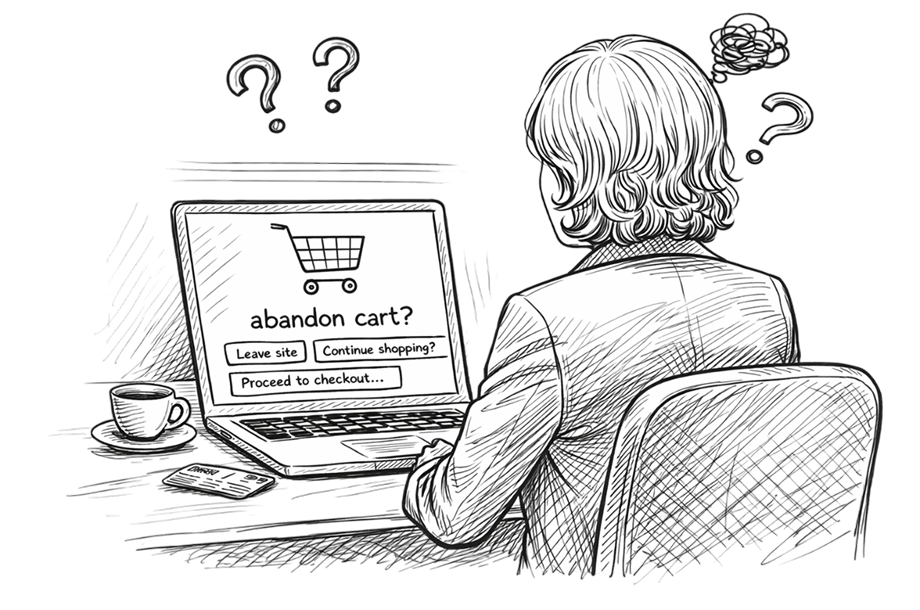
“Decisions slow when the nervous system senses risk — not when information is missing.”
Trust changes how the brain experiences uncertainty
Trust is one of the most powerful neurological modifiers of risk. Neuroeconomic studies, including those by Kosfeld and colleagues, have shown that trust alters the brain’s threat processing and increases willingness to accept uncertainty. Oxytocin, the hormone associated with bonding, reduces the felt cost of ambiguity.
In customer experience terms, this explains why trusted brands convert faster, even when they are more expensive or less convenient. Trust allows the brain to skip defensive processing. Evaluation becomes lighter. Commitment becomes easier.
This is why emotionally consistent brands outperform emotionally flashy ones. Reliability creates safety. Safety creates speed. From a strategy perspective, this means trust is not a branding outcome — it is a decision accelerant. Every touchpoint that increases predictability shortens the path to yes. Every touchpoint that introduces surprise lengthens it.
The affect heuristic: why CX matters more than messaging
Psychologist Paul Slovic’s research on the affect heuristic shows that emotional impressions dominate risk assessment. When something feels good, it is perceived as safer and more valuable. When it feels confusing or irritating, it is perceived as riskier — even when facts are identical. This is why customer experience often outperforms marketing in influencing behavior:
- A smooth onboarding flow increases perceived product quality
- A confusing website increases perceived risk
- A calm support interaction increases loyalty more than discounts
- A single bad experience can override months of positive messaging
Emotion is the brain’s shortcut for complexity.
CX is the system that generates that emotion.
This is why emotion must be treated as a strategic input, not a downstream metric.
The brain does not wait for logic. It decides, then justifies.”
Decision fatigue is the silent killer of modern CX
Modern customers are overwhelmed by choice. Cognitive psychology shows that as the number of options increases, decision quality and decision likelihood decrease. Roy Baumeister’s research on decision fatigue demonstrates that people avoid decisions when cognitive energy is depleted.
This is why:
- too many plans reduce conversion
- too many steps reduce completion
- too much information reduces clarity
- too much personalization reduces trust
Strategic CX design simplifies. It narrows. It guides. It removes cognitive burden from the customer’s brain.
Brands like Apple, IKEA, and Netflix succeed not because they offer everything, but because they structure choice in a way that reduces threat. The brain relaxes when it is guided.
Emotional safety is not comfort — it is control
One of the most misunderstood aspects of CX is the belief that emotional safety means comfort. It does not. Emotional safety means control. Self-determination theory (Deci & Ryan) shows that autonomy is a core psychological need. When people feel they have agency, stress decreases and engagement increases. When they feel manipulated, pressure rises — and resistance follows. This is why:
- transparent pricing builds trustclear cancellation
- policies increase conversion
reversible decisions accelerate commitment
honest limitations increase credibility
progress indicators reduce anxiety
When customers feel in control, the brain releases defensive energy and allows movement.
The four emotional safety systems in customer experience
Across industries, high-performing CX systems consistently support four emotional safety needs:
- Functional safety — Will this work for me?
- Outcome safety — What happens if it doesn’t?
- Identity safety — Does this fit who I am?
- Relational safety — Will they show up for me?
When these four are present, customers move forward quickly and confidently. When any are missing, hesitation appears — often disguised as price sensitivity, procrastination, or disinterest.
This is why CX must be designed as a system, not a series of touchpoints.

Decision velocity is a biological condition before it is a commercial one.
How companies must understand customer emotion as strategy
1. Emotion must be mapped, not measured after the fact
Most companies measure satisfaction at the end of the journey. Strategic companies map emotional risk throughout it. They identify where uncertainty peaks, where fear appears, where confidence drops, and where regret might begin.
Emotion mapping is not soft work. It is predictive risk management.
2. Experience must reduce uncertainty, not just effort
Ease is not enough. Customers can complete a journey and still feel unsafe. Strategic CX removes ambiguity, makes outcomes visible, and sets clear expectations.
This is why shipping notifications, onboarding checklists, progress bars, and confirmation messages are powerful. They calm the nervous system.
3. Reversibility must be designed into decisions
Harvard Business School research shows that people decide faster when decisions feel reversible. Easy returns, trials, and clear exit points reduce perceived threat and accelerate commitment.
Reversibility is safety made tangible.
4. Frontline teams must be trained in emotional intelligence
Emotion is transmitted through people more than systems. Companies that train frontline teams to recognize hesitation, uncertainty, and fear — and respond with clarity instead of pressure — outperform on loyalty and lifetime value.
“Customer experience is not usability. It is risk engineering.”
Customer emotion is the new competitive moat
Products can be copied. Features can be matched. Prices can be undercut. But emotional safety cannot be replicated without culture, design, and discipline. It must be built into the experience from the inside out. This is why companies that lead in CX:
- convert faster
- retain longer
- recover better from mistakes
- command higher trust
- earn loyalty even when competitors are cheaper
Emotion becomes infrastructure.
Safety becomes advantage.
The leadership shift required now
The next generation of growth will not be won by louder messaging, smarter funnels, or more personalization. It will be won by companies that understand a deeper truth:
Customers do not buy when they are convinced.
They buy when they feel safe.
- This requires leaders to move from:
- persuasion → confidence design
- optimization → emotional clarity
- acquisition → trust architecture
- experience → nervous system alignment
Emotion is no longer a CX outcome.
It is a strategic input.And the companies that design for it will move faster, grow deeper, and last longer than those that do not.
Emotion is not decoration.
It is direction.
And safety is the shortest path to yes.